What was the document? - User Manual Overview
As part of my role, I authored a 72‑page comprehensive user manual for a proprietary Human Resource Information System (HRIS) developed for use within our organization and designed to be offered as a cloud‑based SaaS solution to other companies seeking streamlined HR management. The guide was designed to support HR staff and employees in navigating the system’s core functions—such as employee data management, leave tracking, and payroll processing. While I’m unable to share the full document due to company confidentiality, this project reflects my ability to translate complex workflows into clear, user-friendly documentation tailored to real-world needs.
What was the Project Summary?
Human Resource Information System (HRIS)
72-page software user manual covering desktop and mobile workflows using task-based, plain-language documentation with annotated screenshots and validated workflows.
Project Information
Documentation
Process
Tools
Project Highlights
What are the Challenges Solved?
What was the HRIS Manual Scope?
HRIS
User Manual
Core HR
- Employee Records
- Employee Profiles
- Organizational Directory
Employee Self-Service
- Profile Updates
- Password Management
- Notifications
Administration
- Search & Filters
- Reports
- User Settings
Time Management
- Attendance
- Leave Management
- Holiday Calendar
Payroll
- Payslip Viewing
- Payroll Calculation
- Payroll Overview
Cross-Platform Support
- Desktop Interface
- Mobile Interface
What were my contributions?
What are the skills used?
- Technical Writing — Produced task-oriented documentation for desktop and mobile HRIS applications.
- Plain Language — Simplified technical concepts into concise, user-friendly instructions.
- Editing & Proofreading — Reviewed documentation for clarity, grammar, consistency, and accuracy.
- Procedural Writing — Created step-by-step task documentation.
- User-Centered Documentation — Wrote documentation for HR staff, managers, and employees.
- Desktop & Mobile Documentation — Maintained consistency across both platforms.
- Information Architecture — Organized manuals using logical navigation and structure.
- Content Organization — Improved discoverability through clear hierarchy.
- Document Formatting — Applied typography, spacing, tables and styles consistently.
- Annotated Screenshots
- Instructional Graphics
- Callouts & Visual Hierarchy
- SME Collaboration — Validated workflows with the Senior Web Developer.
- Quality Assurance — Verified documentation before publication.
What are the tools used?
Documentation & Authoring
- Microsoft Word — Primary authoring and formatting of user manuals.
- Google Docs — Collaborative drafting and document reviews.
- LibreOffice Writer — OpenDocument editing and documentation.
- Adobe Acrobat — PDF review, commenting, editing, and distribution.
Visual Documentation
- Snagit — Screenshot capture, editing, and annotation.
- ScreenToGif — Animated workflow demonstrations.
- Figma — UI mockups, diagrams, and interface layouts.
- Canva — Icons, graphics, and instructional visuals.
Publishing & Presentation
- Microsoft PowerPoint — Training slides and process diagrams.
- iLovePDF — PDF merging, compression, conversion, and optimization.
Collaboration
- Microsoft Teams — Coordinated with SMEs, developers, QA testers, and stakeholders to review content, validate workflows, and ensure documentation accuracy throughout the project lifecycle.
How did I create the manual?
What do the redacted sample demonstrate?
Image Redacted Documentation Sample
The following redacted excerpt illustrate the structure and presentation of the HRIS user manual page I authored. While proprietary information has been intentionally obscured, this sample demonstrate my approach to organizing technical content, writing clear task-based procedures, using annotated screenshots, and applying consistent formatting and visual documentation practices.
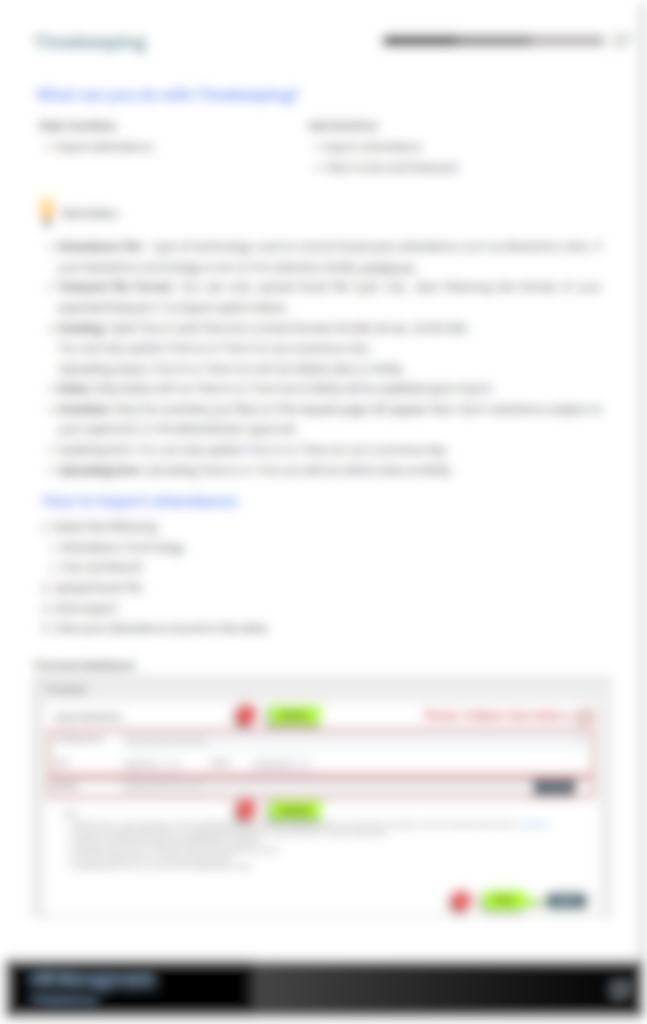

Why were the image samples blurred/redacted?
To respect client confidentiality and protect proprietary information, the documentation samples in this portfolio have been intentionally redacted and blurred. These excerpts are provided solely to demonstrate my technical writing, document organization, and visual communication skills without disclosing confidential information or proprietary system details.
What was the outcome of this Project?
HRIS User Manual
Delivered a structured, task-oriented manual supporting HRIS users across desktop and mobile platforms.
Self-Service
Enabled employees and managers to complete common HR tasks independently through clear, task-based guidance.
Standardization
Established consistent terminology, formatting, and documentation practices throughout the manual.
Knowledge Transfer
Improved understanding through annotated screenshots, visual guidance, and step-by-step procedures.
Maintainability
Created documentation that could be revised as HRIS functionality, interfaces, and procedures evolved.